

CU Correspondent
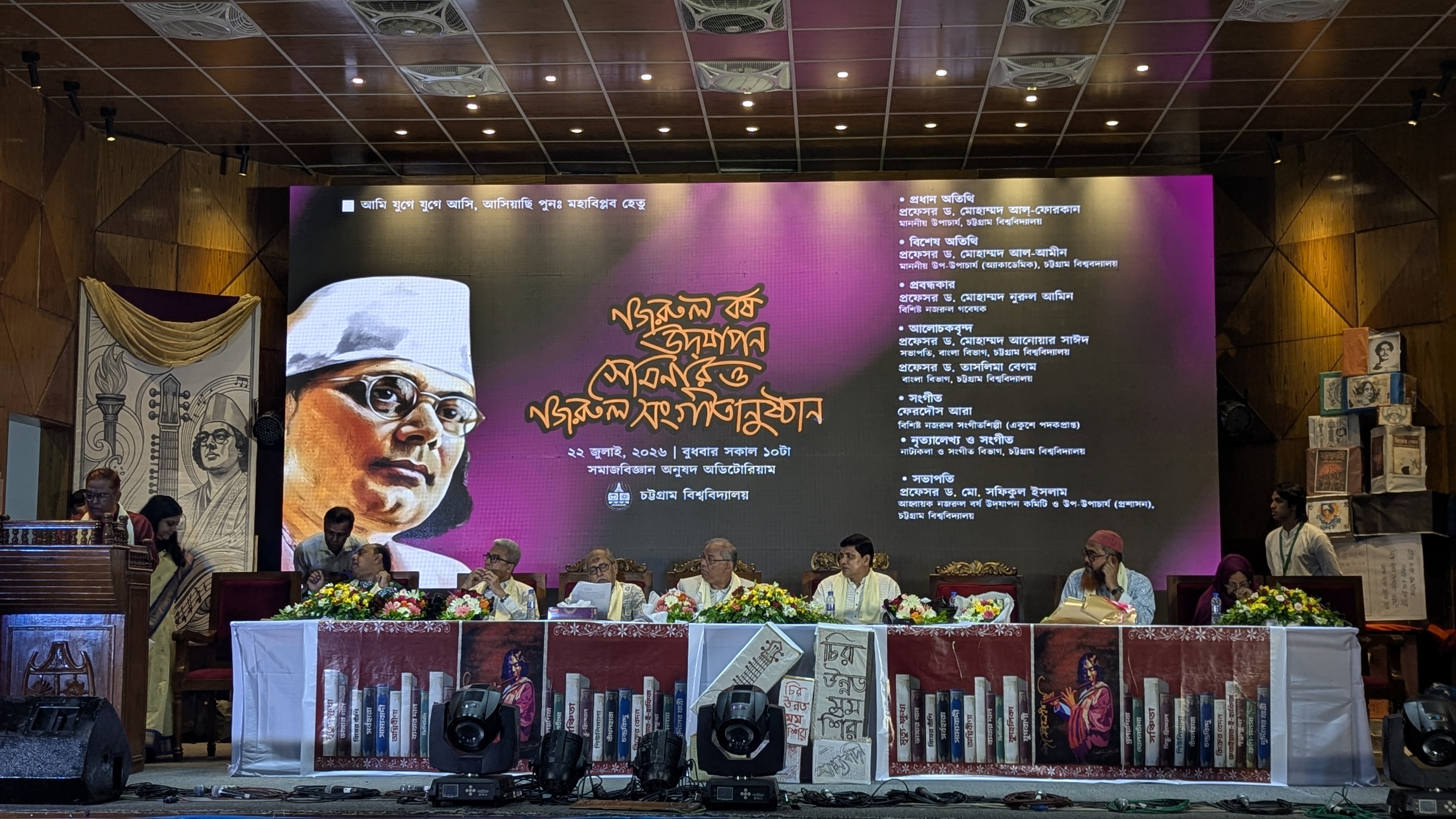
Chittagong University held a day-long seminar and Nazrul music program on Wednesday to mark the 127th birth anniversary of national poet Kazi Nazrul Islam, organized around a theme drawn from his poetry on recurring revolutionary rebirth. The event, part of a year-long “Nazrul Year” program declared by the government, was arranged by the CU Nazrul Year Celebration Committee.
The first session began at 10:30 a.m. at the Faculty of Social Sciences auditorium, moderated by Mishkatul Momtaz, chairman of the Department of Music.
Vice-Chancellor Professor Mohammad Al-Forkan, attending as chief guest, said Kazi Nazrul Islam cannot be confined to a single identity, noting that his writings on love, rebellion, equality, human liberation, religious harmony, and gender equality remain equally relevant today. He recalled that Nazrul’s protest poetry resurfaced in people’s voices during the 2024 mass uprising, and called for collective efforts by teachers, students, and organizations to advance education, research, and the university’s international rankings.
Pro-Vice-Chancellor (Administration) Professor Md. Safiqul Islam, convener of the Nazrul Year Celebration Committee, presided over the event. Pro-Vice-Chancellor (Academic) Professor Mohammad Al-Amin, attending as special guest, described Nazrul as a poet of rebellion and love whose verses were echoed during the July 2024 movement and continue to inspire young people against discrimination.
Nazrul researcher Professor Muhammad Nurul Amin presented a paper titled “National Poet Kazi Nazrul Islam in Patriotism, Universal Humanity, and Mass Awakening.” He said Nazrul transformed his own poverty-stricken, struggle-filled life into extraordinary humanistic expression, driven by firm faith, patriotism, and an indomitable revolutionary spirit.
In the discussion session, Bangla Department Professor Taslima Begum, department chairman Professor Mohammad Anwar Sayeed, and Nazrul Research Centre Director Professor Muhammad Fariduddin Faruk Kabir spoke on the importance of universal humanism, communal harmony, and anti-discrimination positions in Nazrul’s work.
The second session featured performances by music department students, a dramatization of Nazrul’s life and dance performances by theatre department students, and a performance by renowned Nazrul Sangeet artist Ferdous Ara.